Benchmarks¶
urio ships a benchmark comparing both backends against aiofiles across file sizes, in both binary and text mode:
python benchmarks/bench_vs_aiofiles.py                  # human-readable
python benchmarks/bench_vs_aiofiles.py --markdown        # raw numbers (tables)
python benchmarks/bench_vs_aiofiles.py --mode binary     # binary only
python benchmarks/bench_vs_aiofiles.py --cold            # evict cache before reads
python benchmarks/bench_vs_aiofiles.py --files 1000 --size 65536 --repeat 7
The charts below are rendered from a representative run by
scripts/plot_benchmarks.py; re-run the benchmark for raw numbers.
Fairness¶
A microbenchmark is only as honest as its setup, so the harness goes out of its way to give every contender identical conditions:
- Warm cache for everyone. Before any read is timed, the whole working set is pulled into the page cache with a neutral synchronous reader, and each contender additionally gets untimed warm-up runs. Nobody is measured cold while another is measured warm.
- Per-contender isolation. Each contender writes to its own set of files, so it never inherits another contender's dirty pages or writeback pressure — the order in which contenders run cannot advantage any of them.
- Median, not minimum. Times are the median of N timed runs, with the
[min–max] range shown so run-to-run variance is visible rather than hidden
by a single luckiest minimum. Every raw sample is retained (
--json), so mean/best/percentiles can be derived later without re-running. - Binary and text. Every scenario runs twice: once in binary mode (the raw positional path) and once in text mode (the codec + newline-translation path).
- Buffered and durable writes. Each write scenario is measured twice: a
plain buffered
write(lands in the page cache) and awrite+fsyncthat forces the data to disk through each library's natural path — urio via its asyncfsync()(io_uringIORING_OP_FSYNCon the uring backend,os.fsyncin the executor on the thread backend), aiofiles by flushing andos.fsync'ing its fd. Durable writes are far more reproducible because the device, not the cache, sets the pace. - Concurrent. Each scenario opens/operates/closes many files at once — the regime where not parking a thread per operation can matter.
These numbers are noisy and machine-specific
The figures below are a single run on a shared Linux development machine. Buffered writes in particular swing a lot run to run because they become bound by kernel writeback. Treat the shape of the results as the takeaway, not the exact multipliers — and run it on your own hardware.
Test hardware
Unless a chart says otherwise, all Linux numbers on this page were measured on one box:
| CPU | Intel Core i5-6500 (Skylake), 4 cores / 4 threads, 3.2 GHz base (3.6 GHz turbo) |
| RAM | 32 GB |
| Storage | /data: Toshiba DT02ABA200 SATA HDD (spinning disk), ext4 |
| OS / kernel | Ubuntu 26.04 LTS, Linux 7.0 |
| Python | CPython 3.14.6 (GIL); 3.14.6t and 3.15.0b3t (free-threaded) |
The spinning disk matters for the cold-cache reading:
with 32 GB of RAM and small working sets, even --cold reads are served from
the page cache, not the platter. Windows IOCP numbers are from a separate
Windows 10/11 8-core box; the free-threading ZFS comparison and the ARM/macOS
rows name their own hardware inline.
Results¶
Median of 7 timed runs (after warm-up) on the Linux box above (see Test
hardware), CPython 3.14.6. Every bar is one operation × mode × size, coloured by file
size; a bar past the 1.0× line means urio[uring] is faster than aiofiles
(aiofiles ÷ urio[uring]), short of it means slower. urio[thread] tracks
aiofiles closely throughout, so the chart focuses on the io_uring backend.
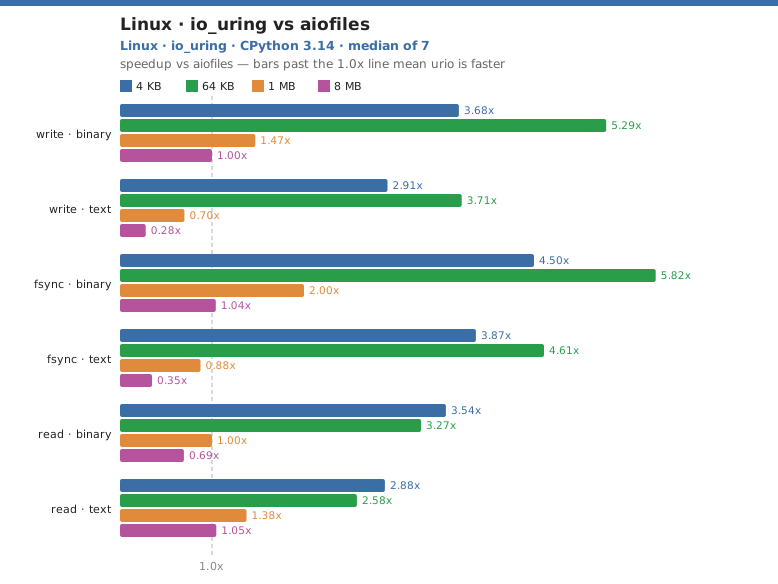
- Buffered writes win at every size up to large — submission batching for
small/medium files (one
io_uring_enterper loop tick instead of one syscall per op) for 2.9–5.3× at 4–64 KB, and zero-copy submission for large binary ones (1.5× at 1 MB, parity at 8 MB; the caller's Pythonbytesis handed to the kernel with no per-writememcpy). Large text writes trail (they re-encode before submitting). - Durable writes (
write + fsync) converge on disk bandwidth — small/medium files still win big on batchedfsync(3.9–5.8×), large binary stays ahead (1.0–2.0×), large text dips below it. - Warm reads win small/medium (2.6–3.5×, where aiofiles' pool starves
under concurrency) and now hold up at large sizes too: reads are zero-copy
(the kernel fills the returned
bytesdirectly, no secondmemcpy) and big reads are punted to io-wq workers so their page-cache copies run on multiple cores — large binary lands at 1.0× (1 MB) / 0.7× (8 MB) (formerly 0.3–0.5×) and large text wins (1.1–1.4×). - Streaming a 128 MB file in 1 MB chunks now runs well past the pool: binary 6447 MB/s vs aiofiles's 3329 (1.9×), text 2249 vs 1783 (1.3×) — the zero-copy read path turned what used to be a bandwidth-bound wash into a clear win.
Cold cache (--cold)¶
The reads above hit a warm page cache — the worst case for io_uring, since a
warm read is a pure memcpy a thread pool can spread across cores. The --cold
flag evicts each file (fsync + posix_fadvise(DONTNEED)) before every timed
read, so reads hit storage — io_uring's intended domain.
Honest result: cold-cache reads land at essentially the same shape as warm — small/medium win, large binary trails (binary 4 KB 3.1×, 64 KB 2.3×, 1 MB 0.76×, 8 MB 0.64×; the 128 MB cold stream runs 2.0×). Two reasons, both worth knowing:
- The reads never actually reach the platter.
/datais a spinning HDD, but the box has 32 GB of RAM and the working sets are small, so even afterfadvise(DONTNEED)the "evicted" data comes straight back from the page cache — the 128 MB cold stream still runs at multi-GB/s, i.e. from RAM, not a disk that tops out near ~150 MB/s. So there is no read latency for io_uring to hide (it hides latency, not bandwidth). io_uring's real win needs genuinely latency-bound storage — a loaded disk, network filesystem, or high queue depth that actually misses cache — which this small-working-set setup never induces. - At these sizes reads are dominated by per-op and copy cost, not I/O wait. So cache state barely moves them, and the warm shape carries straight over: small/medium win (per-op batching), large binary trails (many concurrent copies saturate memory bandwidth wherever they run).
So cold testing did not flip the read story on this hardware; it confirmed where the real costs are. The durable-write and high-concurrency write wins (below) remain the dependable advantages.
Filesystem impact: ext4 vs ZFS¶
The numbers above are ext4 on a SATA HDD. Running the same urio build (GIL, CPython 3.14.6, warm, median of 7) on a second Linux box backed by ZFS shows one operation change character completely: durable writes.
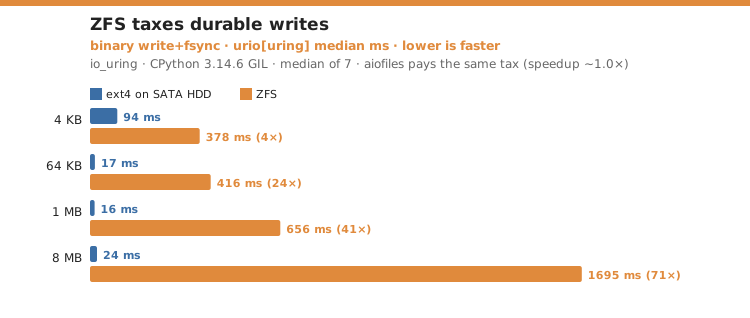
On ZFS every fsync forces a ZIL + transaction-group commit, so write+fsync
latency explodes with size — urio[uring] 64 KB 17 → 416 ms, 1 MB 16 →
656 ms, 8 MB 24 → 1695 ms (24–71× slower than ext4). Three things make this
honest rather than alarming:
- It is the filesystem's cost, not urio's. aiofiles pays the identical ZIL
tax on the same box, so urio's speedup vs aiofiles stays ~1.0× on the large
durable writes — the bar chart above is absolute milliseconds precisely because
the speedup ratio hides the effect. And many-small-file durability still wins
big (4 KB
write+fsync2.4×, 378 vs 902 ms): aiofiles issues thousands of individualfsyncs while urio batches them into oneIORING_OP_FSYNCsweep, a gap ZFS's per-commit cost actually widens. - Durable writes are the systematic change. Small/medium reads still win big (4 KB 3.3×, 64 KB 4.3×); ZFS's ARC even absorbs 1 MB buffered writes (17 → 12 ms), though buffered writes overall are noisier here under txg pressure.
- This is a ZFS data point, not a clean A/B. The ZFS box is also a different CPU (8-thread Xeon vs 4-core i5), RAM, and kernel — and a live Proxmox host — so treat it as "here is how urio behaves on ZFS," not an isolated filesystem benchmark.
The practical rule: on a copy-on-write filesystem like ZFS, fsync-heavy
workloads are bound by the commit, not the async library — reach for urio's
batched fsync when you have many files to make durable, and expect large
single-file durable writes to converge with everything else on the device.
Real-world workload: Sanic static file serving¶
Microbenchmarks isolate the I/O layer; this section measures urio inside
someone else's production code. Sanic serves every
app.static file through aiofiles.open (via the module-global
sanic.compat.aio_open), so rebinding one name at runtime —
sanic.compat.aio_open = urio.open — swaps the file layer of a major web
framework with no source patched: urio.open is awaitable and an async
context manager exactly like aiofiles'.
Method: Sanic 25.12.1, single process, access log off; an aiohttp load
generator on the same machine with 32 concurrent connections; 100-request
warm-up (warm page cache), then 12-second timed runs, median of 3; served
bodies verified byte-identical (md5) to the on-disk files in both modes.
CPython 3.12 throughout. Requests per second, urio ÷ aiofiles as the ratio:
4-core Intel i5-6500 (Skylake), Linux, ext4 — urio on io_uring:
| File | aiofiles | urio | ratio |
|---|---|---|---|
| 4 KB | 1,719 | 2,258 | 1.31× |
| 64 KB | 1,678 | 2,133 | 1.27× |
| 1 MB | 866 | 889 | 1.03× |
8-thread Intel Xeon E5-1620, Linux, ZFS — urio on io_uring:
| File | aiofiles | urio | ratio |
|---|---|---|---|
| 4 KB | 1,262 | 1,619 | 1.28× |
| 64 KB | 1,206 | 1,504 | 1.25× |
| 1 MB | 616 | 661 | 1.07× |
14-core Apple M4 Pro, macOS — urio on the thread backend:
| File | aiofiles | urio | ratio |
|---|---|---|---|
| 4 KB | 4,524 | 4,694 | 1.04× |
| 64 KB | 4,300 | 4,451 | 1.04× |
| 1 MB | 3,175 | 3,219 | 1.01× |
Three things worth reading out of the numbers:
- The win is per-op cost, not copy bandwidth — so more cores do not rescue the thread pool. A plausible objection is that a 4-core box starves aiofiles' executor and a bigger CPU would close the gap. The 8-thread box answers it: the ratio barely moves (1.31×/1.27× → 1.28×/1.25×). Each request costs aiofiles open + read(s) + close, each a GIL-mediated thread hop, and extra cores don't make those hops cheaper — while urio batches them into the ring. Median latency drops accordingly (4 KB p50 18.7 → 14.3 ms on the 4-core box, 24.3 → 19.3 ms on the 8-thread box).
- At 1 MB both modes converge — the Python HTTP client and server stack becomes the bottleneck (~900 MB/s through the loopback on the 4-core box), so the file layer stops mattering. That row is a floor on urio's benefit, not a ceiling.
- On macOS urio runs its thread backend and lands at parity or a few
percent ahead (its read path is a single
FileIO.readallexecutor hop) — swapping urio in never costs anything on platforms without a native backend.
The same swap-and-measure exercise on
aiologger's unmodified
AsyncFileHandler (an awaited write+flush per log record) gave 2.3×
sequentially and 5.2× with 100 concurrent writers on the 4-core io_uring box
— the per-op story, amplified.
The same opportunity exists beyond aiofiles
Frameworks that moved off aiofiles didn't move off thread pools:
anyio's Path and open_file — what
Starlette and FastAPI use for static files — dispatch every file
operation to a worker thread via to_thread.run_sync. An
io_uring-backed file layer could slot in there just as it does for
aiofiles; today that means using urio.open/urio.Path directly in
application code.
Windows (IOCP backend)¶
The Windows IOCP backend is production-validated on
Windows 10/11 (CPython 3.14, GIL and free-threaded): the full test suite
(190 tests, including the differential suite against the stdlib io oracles)
and a concurrency + cancellation + error-path stress test both pass. Getting there fixed three cross-platform Windows correctness bugs — every
fd is now opened O_BINARY (without it the CRT runs in text mode and
os.read/os.write translate CRLF, corrupting binary data and desyncing
offsets), Path.replace() overwrites via os.replace (os.rename fails on
Windows if the target exists), and IOCP exclusive-create uses CREATE_NEW
(O_EXCL / 'x' mode now raises FileExistsError).
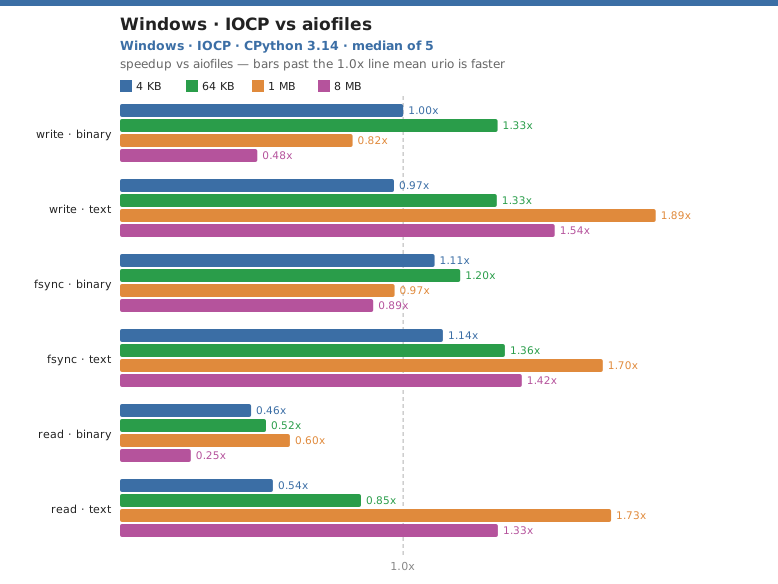
Measured against aiofiles (median of 5, warm cache, concurrent, CPython 3.14),
as a speedup (aiofiles ÷ urio[iocp], >1 means urio is faster):
| Workload | buffered write | write+fsync | read |
|---|---|---|---|
| binary, small/med (4–64 KB) | 1.00–1.32× | 1.11–1.20× | 0.47–0.51× |
| binary, large (1–8 MB) | 0.50–0.82× | 0.90–0.97× | 0.25–0.61× |
| text, small/med (4–64 KB) | 0.97–1.32× | 1.14–1.36× | 0.54–0.85× |
| text, large (1–8 MB) | 1.53–1.89× | 1.42–1.71× | 1.34–1.74× |
So urio[iocp] is at parity-to-winning on buffered writes (zero-copy writes,
the same technique as the io_uring backend; only large binary buffered writes
soften), wins on durable writes except large binary (~0.9×), and — with
reads now zero-copy too (the kernel fills the returned bytes directly) —
wins large text outright (1.3–1.9× across write/fsync/read; streaming a
128 MB binary file runs 2.1 GB/s vs aiofiles' 1.5). The loss that remains is
binary reads (0.25–0.61×).
The binary-read loss is structural on Windows: a warm-cache overlapped
ReadFile completes synchronously, so the kernel performs the copy inline on
the submitting loop thread — one core — while aiofiles' pool runs N copies in
parallel. Zero-copy reads removed the second (Python-side) copy, which is why
streaming and text flipped to wins, but the inline kernel copy remains
single-threaded. A single 8 MB file reads at parity with aiofiles; the gap opens
under concurrency.
How completions are reaped (the key design). urio reaps completions on the
event-loop thread, the Windows analogue of the Linux eventfd design — no poller
thread, no call_soon_threadsafe. asyncio's ProactorEventLoop already owns an
I/O completion port and blocks on it; urio opens files with overlapped I/O,
associates them with that port, and submits reads/writes (with offsets, which
the stock _overlapped module cannot express) through a small native object that
registers each op with the proactor. When the kernel posts a completion the loop
wakes itself and resolves the future inline — a per-op round-trip floor of
~41 µs. On non-ProactorEventLoop loops (e.g. SelectorEventLoop) urio
falls back to a single poller thread that reaps completions in batches
(GetQueuedCompletionStatusEx) and delivers each batch with one
call_soon_threadsafe.
Concurrent binary reads are the weakest case (down to ~0.25× at 8 MB) for that
inline-copy reason; writes and durable writes are competitive and large text now
wins. The backend stays opt-in (URIO_WINDOWS_IOCP=1) and Windows defaults to
the thread pool — binary reads are the deciding factor, and the thread pool
spreads the read copy across cores.
ARM / aarch64 (Jetson Nano — thread fallback)¶
urio is validated on a Jetson Nano (aarch64, Ubuntu 18.04, Tegra X1 4-core).
Its kernel is 4.9, which predates io_uring, so urio automatically falls back to
the thread backend — the intended behaviour on old kernels — and the
manylinux2014 aarch64 wheel installs and runs on glibc 2.27.
Here the comparison is urio[thread] vs aiofiles (best of 3, warm cache,
concurrent), as a speedup (aiofiles ÷ urio[thread], >1 means urio is faster):
| Size | binary write | binary read | text write | text read |
|---|---|---|---|---|
| 4 KB | 0.96× | 1.02× | 0.97× | 1.18× |
| 64 KB | 1.07× | 1.07× | 0.97× | 1.05× |
| 1 MB | 0.94× | 1.04× | 1.90× | 0.65× |
| 8 MB | 0.77× | 0.53× | 1.04× | 0.98× |
Durable (fsync) writes land at 0.88–1.11×. The headline is that the thread
backend tracks aiofiles within ~±10% on ARM, as designed — it is the same
thread-pool strategy — while urio's text-write coalescing still wins on large
text writes (1.9×). The slower spots are large warm reads (executor copy on a
slow microSD), the same memcpy-bound shape seen elsewhere. (On a newer-kernel
ARM box, urio would instead use the native io_uring backend.)
32-bit ARM io_uring (Raspberry Pi)¶
io_uring also runs on 32-bit ARM. On a Raspberry Pi (armv7l, kernel
5.15, CPython 3.12) urio uses its native io_uring backend — validated correct
(read/write/fsync/concurrency) and faster than aiofiles on the workloads that
matter on a small box. Median of 3, warm, concurrent
(aiofiles ÷ urio[uring]; raw samples in benchmarks/data/linux-armv7l-*.json):
| Scenario | write | write+fsync | read |
|---|---|---|---|
| 300 × 4 KB binary | 0.22׆ | 1.36× | 2.89× |
| 300 × 4 KB text | 1.35× | 2.07× | 2.18× |
| 150 × 64 KB binary | 2.21× | 2.43× | 2.30× |
| 150 × 64 KB text | 1.18× | 0.63× | 2.33× |
| 20 × 1 MB binary | 0.35× | 0.77× | 0.49× |
The dependable win is reads: 2.2–2.9× across small/medium files — larger than
on x86, because on a weak, RAM-starved Pi the thread pool contends hardest while
urio's single loop thread plus io_uring sails through. Small/medium durable
writes also win (up to 2.4×): one batched IORING_OP_FSYNC sweep versus
aiofiles' hundreds of executor fsyncs on a slow microSD. Large (1 MB) files
flip to a loss (0.4–0.8×) — few files, no concurrency to exploit, throughput- and
memcpy-bound. Buffered writes are very noisy on this SD card (†the 300×4 KB
binary 0.22× is a writeback outlier — the fsync rows are the reliable write
metric). Working sets are kept small (the box has ~470 MB free).
Build note: the io-uring crate ships no 32-bit-ARM syscall bindings, so the
armv7 wheel is built with RUSTFLAGS=--cfg io_uring_skip_arch_check — safe
because the io_uring ABI structs are fixed-width, and validated on this Pi.
Free-threaded Python (no-GIL) changes the read story¶
Free-threaded CPython (PEP 703, the t builds) removes the GIL, and that
reshapes the warm-cache comparison. urio runs GIL-free too — the native
module declares free-threaded support (gil_used = false), and the three native
classes are #[pyclass(unsendable)], so each ring stays confined to its
event-loop thread. Crucially, urio has the same thread-pool mode aiofiles
does: its thread backend runs the blocking syscalls in the loop's executor,
so under no-GIL its warm-read copies parallelise across all cores identically.
So this is not urio "losing" free-threading — you keep io_uring/IOCP for the
write, fsync, and latency wins, and drop to urio's thread backend for warm
reads, where it matches aiofiles. What the numbers below isolate is only the
native backends' warm-read edge — the advantage a single loop thread held over
a GIL-bound pool — narrowing as that pool is unshackled.
Measured on the same interpreter version, GIL vs no-GIL (CPython 3.14.6 vs
3.14.6t, x86_64 4-core), binary reads, as a speedup
(aiofiles ÷ urio[uring]):
The chart below pairs the Linux io_uring rows with the Windows IOCP rows (detailed below) — the same free-threading effect shows on both backends: GIL (blue) vs no-GIL (orange), speedup vs aiofiles.
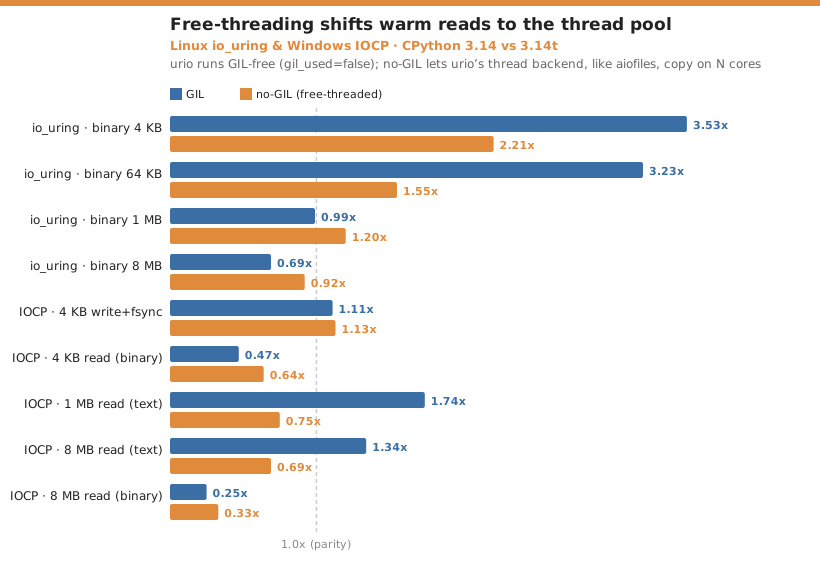
| read size | GIL | no-GIL | aiofiles ms (GIL → no-GIL) |
|---|---|---|---|
| 4 KB | 3.53× | 2.21× | 287 → 176 |
| 64 KB | 3.23× | 1.55× | 72 → 42 |
| 1 MB | 0.99× | 1.20× | 26 → 27 |
| 8 MB | 0.69× | 0.92× | 25 → 28 |
Free-threading narrows urio[uring]'s small/medium warm-read edge — but it now
stays a clear win at every size. With no GIL, aiofiles and urio[thread] copy
read data into Python bytes in parallel across all cores, so their small
reads speed up sharply exactly where a GIL-bound pool was starving — aiofiles
4 KB 287 → 176 ms, 64 KB 72 → 42 ms — and the small-read multiplier compresses
(4 KB 3.53× → 2.21×, 64 KB 3.23× → 1.55×). Large reads used to be the story's
weak spot; with zero-copy reads (the kernel fills the returned bytes
directly) plus the io-wq punt for ≥1 MB reads, they sit at parity under the
GIL and slightly ahead without it (1 MB 0.99× → 1.20×, 8 MB 0.69× → 0.92×) —
free-threaded CPython's costlier refcounting hurts the pool more than the ring.
(3.15.0b3t sharpens the picture further: binary reads win at every size —
4 KB 1.77×, 64 KB 1.38×, 1 MB 1.14×, 8 MB 1.31× — while small/medium fsync
stays a 2.1–2.5× io_uring win.)
Writes are unaffected: urio's submission batching still wins on small/medium buffered writes under no-GIL (~1.1–2.2×), because that path is syscall-bound, not copy-bound. And urio's own thread backend speeds up exactly like aiofiles (same executor strategy) — so the practical rule on free-threaded Python is reads favour the thread pool, writes favour io_uring, and urio gives you both: drop to its thread backend for warm reads (parity with aiofiles), keep io_uring for writes.
Takeaway: urio is free-threaded-ready and, like aiofiles, drops to a
parallelised thread pool for warm reads. Free-threading narrows only the
native backends' warm-cache read edge (the weakest, memcpy-bound case); the
durable advantages remain write batching and latency-bound / cold I/O —
and for warm reads you simply use the thread backend, losing nothing to aiofiles.
Python version support
Validated free-threaded on 3.14t and 3.15.0b3t. PyO3 0.29 (urio's binding) supports the free-threaded build only from 3.14 onward — it refuses to compile against 3.13t — so 3.14t is urio's free-threaded floor. io_uring loads and read/write round-trips are correct on both.
Windows IOCP under no-GIL — reads lose, writes hold¶
The IOCP backend reaps and copies each read on the single event-loop thread (the
ProactorEventLoop design above), while aiofiles' pool — and urio's own thread
backend — fan the copy across cores. So IOCP's characteristic weakness is
reads, and free-threading deepens it. These are the IOCP · rows in the
free-threading chart above.
Median of 5 on Windows 10 (8-core), CPython 3.14 (GIL) vs 3.14t (no-GIL), same
zero-copy IOCP build, against aiofiles (aiofiles ÷ urio[iocp], >1 means urio is
faster):
| Size | Op | GIL | no-GIL |
|---|---|---|---|
| 4 KB | write+fsync (binary) | 1.11× | 1.13× |
| 64 KB | write+fsync (binary) | 1.20× | 1.08× |
| 4 KB | read (binary) | 0.47× | 0.64× |
| 8 MB | read (binary) | 0.25× | 0.33× |
| 1 MB | read (text) | 1.74× | 0.75× |
| 8 MB | read (text) | 1.34× | 0.69× |
IOCP wins on durable writes and loses on binary reads — and free-threading's
clearest effect is on text reads. Binary reads lose in both GIL states
(0.47× → 0.64×, 0.25× → 0.33× — the warm ReadFile copy completes inline on
the loop thread). But large text reads, which win under the GIL (1.34–1.74×
since zero-copy reads landed), drop to ~0.7× without it — free-threading
lets aiofiles' pool and urio's own thread backend run the decode + copy across
all cores, while IOCP's reap stays on the loop thread. Durable small writes hold
(1.11× → 1.13×). The binary-read loss is inherent to the loop-thread design,
which is why IOCP remains opt-in.
The thread backend, by contrast, tracks aiofiles everywhere. Two design
choices make it hold up under free-threading. Writes go through an unbuffered
io.FileIO rather than os.write (which on Windows is ~7× slower for large
buffers), keeping binary writes at parity. And the text codec (encode/decode +
newline translation), which otherwise runs on the single loop thread, is
offloaded to the executor for payloads ≥32 KiB on free-threaded interpreters
(inline under the GIL, where the hop would only add latency) — so concurrent
files' codecs parallelise across cores. The thread backend's no-GIL reads then
track aiofiles: 1 MB text read 0.92×, 8 MB text read 0.98×, 8 MB binary
read 0.88×, 1 MB binary read 1.09×; text and binary writes are ~parity
(8 MB binary write 0.93×, text writes 0.97–1.01×).
Practical rule on free-threaded Windows: prefer urio's thread backend for read-heavy work. The thread backend is at parity with aiofiles for both binary and text; IOCP's loop-thread reaping is an asset under the GIL (no cross-thread hop, and it keeps its durable-write edge — 1.13× — even without the GIL) and a liability for copy/codec-bound reads without it. This mirrors the Linux result — free-threading favours the thread pool for copy/codec-bound work. IOCP stays opt-in; the thread pool remains the Windows default.
Durable writes converge on the device¶
For write+fsync, urio and aiofiles land in the same band — fsync makes the
storage device the bottleneck, so the async library stops mattering. urio is
competitive throughout and faster on some sizes; differences sit within
run-to-run noise on a shared machine. Reproduce on your own hardware:
A few mechanics behind the numbers¶
Why writes win. Every queued operation reaches the kernel in a single
io_uring_enter per event-loop tick instead of one syscall per op — a
500-write workload issues ~15 enters, not 1500 — and large writes point the
kernel at the caller's Python bytes directly, with no per-write memcpy.
Large text writes trail because they re-encode before submitting.
Why reads hold up. The kernel writes into an uninitialised Python bytes
that is handed back as-is (no memset, no second copy — only the bytes
actually read are ever exposed), and reads of 1 MB and up are punted to io-wq
workers so concurrent warm-cache copies run on multiple cores. That is what
moved large binary reads from 0.3–0.5× to parity-ish and flipped streaming to
a win.
writelines is one submission. The whole batch goes to the ring as a
single vectored writev, so it pays one round-trip instead of one per line —
the saving scales with the number of lines.
Sized text read(n) is one round-trip. It requests the whole remaining
deficit from the raw layer in one go (matching the binary path); what remains
is the incremental Python decode. Line-oriented text iteration refills a
128 KB chunk per round-trip and decodes incrementally, so streaming a large
text file line by line trails a C TextIOWrapper — read binary and
bulk-decode if text line-streaming throughput is critical.
The thread backend tracks aiofiles — reads and writes, every platform. It
is the same thread-pool strategy aiofiles pioneered, and it is what urio uses
where no native backend is available or selected. Both reads and writes go
through io.FileIO, the same C-level object a Python file wraps.
Takeaways¶
- Reach for urio's io_uring backend for high-concurrency reads and writes, durable writes, and workloads bound by I/O latency.
- Since reads became zero-copy (the kernel fills the returned
bytesdirectly, large reads fanned out to io-wq workers), reads are faster-to-parity across the board on Linux — the one soft spot left is many concurrent 8 MB warm reads (~0.7×), which saturate memory bandwidth wherever they run. On Windows the IOCP read copy is still loop-thread-bound, which is why IOCP stays opt-in. - One API, the best available backend at runtime — and a benchmark you can rerun on your own hardware to see where you land.